
Responsible AI
AI should deepen understanding—not replace human judgment.
Mind Journey uses AI as an assistive intelligence layer designed to support understanding within defined boundaries, while keeping human judgment central to important decisions.
Explore for Professionals →AI supports understanding. Human judgment guides decisions.

WHY AI
Understanding becomes harder when
information stays fragmented.
Psychological and developmental understanding can involve different kinds of information across different moments. Looking at those pieces separately can make it harder to see how they relate


Mind Journey approaches intelligence as a way to help bring relevant information into context-not as a way to reduce a person to a score, response, or isolated moment.
ASSISTIVE INTELLIGENCE
AI has a supporting role-not the final
word.
AI can help organize, relate, and highlight information so the human context remains visible and the
journey stays understandable.
Structure
Connection

Context

Time

Insight
Clear boundaries
AI can assist understanding without
becoming the authority
Responsible AI should be clear about what it can support, what it cannot decide, and where human judgment remains essential.
AI is not a psychologist.

AI does not replace professional judgment.
AI does not independently establish a clinical diagnosis.

AI is not a source of absolute certainty.

AI is not an autonomous decision-maker.
Pattern does not mean diagnosis. Association does not mean conclusion.
CONTEXT MATTERS
A score alone rarely tells the whole story.
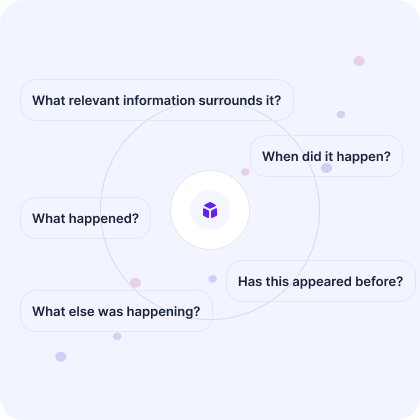
A single assessment result, check-in, response, or observation is one part of a larger picture. Meaning can change when we consider what happened, when it happened, what surrounded it, and whether similar information has appeared before.
A pattern can invite closer attention without becoming a diagnosis or a conclusion.
Across Time
Understanding changes when we can see
the journey.
A single moment can tell you where something stands today. A connected journey can help provide perspective on how experiences, patterns, and progress change over time.

A trajectory is a way of understanding change-not a prediction of a person's psychological future.
Explainability
Understanding changes when we can see
the journey.
A single moment can tell you where something stands today. A connected journey can help provide perspective on how experiences, patterns, and progress change over time.
Sometimes the responsible answer is that there is not enough information yet.
No conclusion can be a valid outcome.
HUMAN OVERSIGHT
Human judgment stays where it matters.
AI can support a review process. It does not inherit a person's or professional's responsibility for understanding context, weighing limitations, or making appropriate professional decisions.
Mind Journey should support reflection without suggesting that a system knows a person better than they know themselves.
Professional interpretation remains responsible for determining relevance, context, limitations, and appropriate next steps within the professional's role and scope.
Explore for Professionals →Information.
AI-Assisted Synthesis.
Professional Review.
Professional Judgment.
Appropriate Actions.
Professional Context.
AI & Your Information
Sensitive information requires responsible handling.
Using AI responsibly also means being clear about when AI is involved, why processing is needed,
and what boundaries apply to sensitive information.
Detailed information about data handling, permissions, retention, AI processing, and applicable user
controls belongs in Mind Journey's Privacy & Data experience as those policies and technical
decisions are confirmed.
LIMITATIONS
Responsible AI includes knowing its limits.
AI should be used with awareness of what it can support and what it cannot decide, especially when psychological and developmental information is involved.
Incomplete information.

Inaccurate information
Missing context
Ambiguity

Changing circumstances

Model limitations
Bias
Human oversight
There may not be enough information yet.
Responsible intelligence should be able to leave a question open when the available information does not support a conclusion.
OUR APPROACH
How Mind Journey thinks about AI.
AI should be designed to support understanding, not replace it. That means keeping purpose, context, and human judgment visible throughout the journey.

Purposeful.
Human-Centered.
Context-Aware
Longitudinal
Explainable

Bounded
Human-Guided

Privacy-Conscious
Human at the center. AI in the system. Judgment in human hands.
RESPONSIBLE INTELLIGENCE
Understand the intelligence behind the
journey.
AI can support deeper understanding when it is used intentionally, with clear boundaries, and with human judgment at the center.
AI supports understanding. Human judgment guides decisions.